

Setting Up a Home Practice Space for Musicians
Why a Dedicated Corner Beats a Sofa and a Music Stand
Most players practise wherever there is room — in front of the telly, at the end of the kitchen table. It works, up to a point. Chamber music, though, asks us to listen across parts and judge balance and intonation in fine detail for an hour at a time, and an improvised practice spot encourages improvised listening.
Carve out a permanent corner and the change is immediate. The instrument stays out, the stand stays up, the pencil and scores stay where you left them. You can play for twenty minutes between other commitments and walk away without tidying up. Your brain also learns that this corner means work, so settling into it becomes the start of concentration rather than the last thing you have to arrange.
It need not be a whole room. Two square metres of a spare bedroom or a quiet alcove is plenty, as long as it is yours and not in the middle of everything.
Choosing the Spot and Taming the Room
Aim for a space that lets you hear yourself honestly. Bare boards, bare walls and hard surfaces create a bright, fluttery sound that flatters nothing: fast passages blur and an out-of-tune fifth is harder to pin down. A heavily carpeted box with the curtains shut is the opposite problem — so dead you cannot tell how your tone will carry.
You want something in between:
- Lay a rug with an underlay over hard flooring, large enough to sit beneath your chair and stand.
- Hang curtains and put a bookcase against at least one wall; shelves of books and scores are excellent, cheap diffusers.
- Keep a sofa or a couple of cushions in the room to soften the top end without killing the sound.
- Avoid sitting close and square-on to a bare wall, which slaps the sound straight back at you.
- Leave the middle of the room open, both to breathe and to give string players a clear arc for the bow.
Check the neighbours before you settle. A corner away from a shared wall — an internal wall, or a spot beside a hallway — spares everyone. Cellists and bassists should also mind the ceiling and the swing of the bow; a low light fitting in the wrong place becomes a permanent irritation.
The Stand, the Chair and Your Body
A flimsy folding stand is fine for a gig; for daily practice it is a false economy. Buy the sturdiest you can justify — a solid desk with a heavy base and a ledge deep enough to hold a thick score without slipping. Page turns should be quiet and quick. If you play chamber music, two stands are better than one: your part on one, the score on the other.
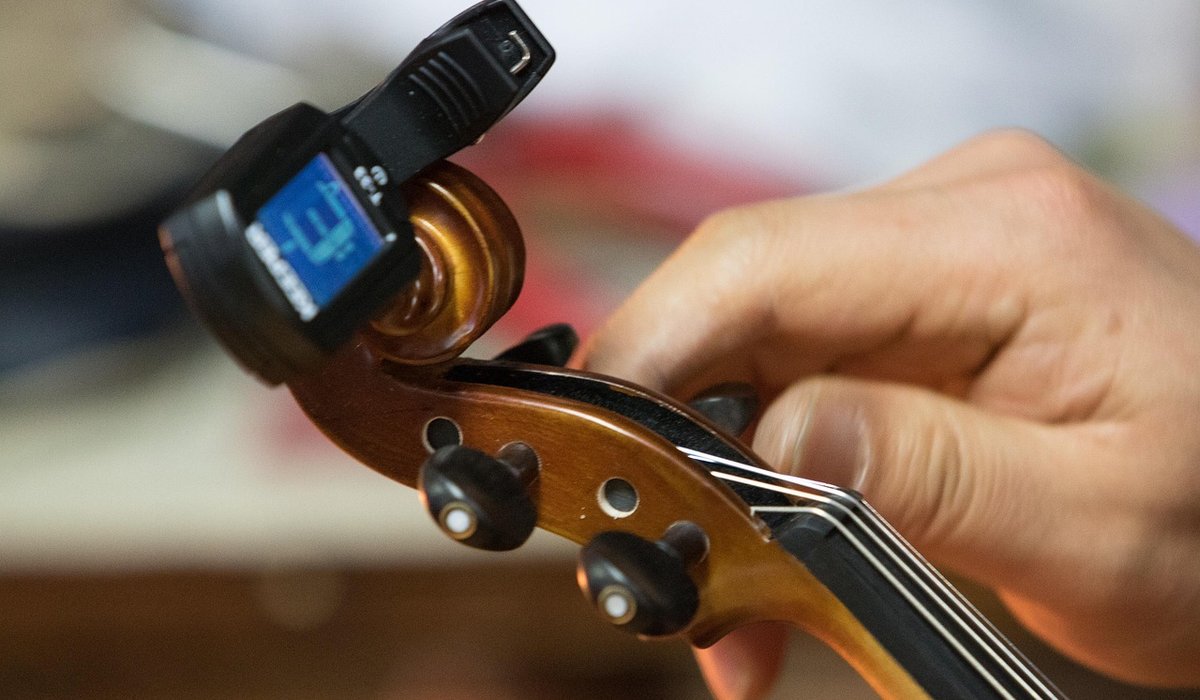
The chair matters just as much. A firm, flat-seated, non-swivelling chair at the right height will do more for your playing than most accessories. Sit so your thighs are roughly parallel to the floor and both feet are planted; cellists often prefer a slightly lower stool, and classical guitarists a footstool. Never use anything soft, tilting or on castors. Add a small side table for rosin, a pencil, water and a tuner, plus an endpin anchor if your floor is slippery.
Lighting You Can Live With for Two Hours
You cannot play what you cannot read, and most of us are reading small print, old editions and our own pencil marks. Overhead light alone throws the shadow of your head and the stand's top edge across the page. An adjustable lamp solves it.
- Choose a warm-white bulb, roughly 2700 to 3000 kelvin, which is kind to the eyes over long sessions.
- Angle the light across the page from the side — not into your eyes, and not bouncing off glossy paper.
- Use a flexible arm, clamped to the stand or set on a floor lamp just behind your shoulder.
- Top up with daylight where you can, but do not rely on it; a north-facing room dims noticeably by mid-afternoon.
Keeping the Peace with Neighbours
It is the repeated passage, not the music, that tries a neighbour's patience — the same four bars for the twentieth time. A little planning prevents most friction.
- Keep to a predictable window, avoiding very early mornings and late evenings. A friendly note through the door explaining your usual hours is worth more than an apology afterwards.
- Use a practice mute for slow technical work, but take it off for tone and intonation. Mutes change the instrument's response, and you will not learn a real sound through one.
- Push a heavy bookcase against the shared wall and keep the rug and soft furnishings in place.
- For very late work, consider an electric instrument with headphones, or spend the time reading scores and listening.
- Invite the neighbours in when a piece is ready. A short recital turns a nuisance into a supporter.
Keeping the Space Ready to Play
The best practice space is the one you can use in thirty seconds. Leave the stand at your height, the instrument within reach, and your current scores in a folder on a shelf rather than in a pile on the floor. A humidity gauge is a small investment that protects wooden instruments through a British winter.
Remember, too, that this corner is for listening as well as playing. Keep headphones or a small speaker nearby and spend some sessions following a score while a recording plays. Hearing how a quartet balances a phrase, then trying it yourself, is one of the quickest routes to genuine chamber music appreciation — and it begins with a chair, a stand and a corner of your own.


Ensembles
-
From rural churches to urban concert halls, British festivals offer intimate performances and learning opportunities. Research programmes early, book accommodation, and consider volunteering.


Concerts



-

Long established fact that a reader will be distracted
-

Long established fact that a reader will be distracted
-

Long established fact that a reader will be distracted



Repertoire
Karla Gleichauf
12 May 2017 at 05:28 pm
On the other hand, we denounce with righteous indignation and dislike men who are so beguiled and demoralized by the charms of pleasure of the moment
M Shyamalan
12 May 2017 at 05:28 pm
On the other hand, we denounce with righteous indignation and dislike men who are so beguiled and demoralized by the charms of pleasure of the moment
Liz Montano
12 May 2017 at 05:28 pm
On the other hand, we denounce with righteous indignation and dislike men who are so beguiled and demoralized by the charms of pleasure of the moment